Friday, December 23, 2011

Evolution Professor: There’s Plenty of Time for Giraffes to Evolve

In our previous post we discussed an evolution professor who, in one blog post, makes two fundamental mistakes. But his mistakes don’t stop there. The professor also explains why he thinks mathematicians are wrong to think there isn’t sufficient time for evolution, but the professor ends up making their case for them.

When Darwin was developing his theory, the age of the earth was not well understood. Darwin himself advocated a 400 million year or more age for the earth, which he considered to be required for the new species to evolve. This requirement became particularly evident when William Thomson (later Lord Kelvin), only a few years after Darwin had published his book on evolution, argued that the earth could be no older than 100 million years. Thomson later revised that figure downward to as little as 20-40 million years.

The 100 million years that Thomson allowed was not nearly long enough for evolution to work. “Thomson’s views of the recent age of the world,” wrote Darwin, “have been for some time one of my sorest troubles.” As Cherry Lewis of the University of Bristol has explained, “The age of the Earth was hugely important for people like Darwin who needed enormous amounts of time in which evolution could occur. As Thomas Huxley, Darwin’s chief advocate said: ‘Biology takes its time from Geology’.”

Darwin and Huxley worked to overthrow Thomson’s time restriction. Darwin enlisted his son George, a mathematician at Cambridge, to rework Thomson’s calculations. Eventually, around the turn of the century, geology rejected Thomson’s arguments. The usual reason given for this is that Thomson was unaware of radioactivity as a source of thermal energy, though it seems the story is more complicated than this.

In any case, geology soon extended the age of the earth into the billions of years, and evolution’s requirement for long time periods, so it seemed, was fulfilled.

It is now known, however, that evolution has nowhere near the eons of time it requires. Indeed, the time windows available are even less than those allowed by William Thomson, which themselves were unacceptable to the evolutionists. This falsification of evolution’s expectation does not derive from the age of the earth, but rather from the fossil record. We now know that, even with billions of years of earth history, the major events in the fossil record take place in time windows that are no longer than a few tens of millions of years or even less.

The professor recounts the story of Darwin versus Thomson and naively thinks he has another victory for evolution when in fact unbeknownst to him he is revealing yet another problem:

Kelvin ultimately settled on a more narrow range of 20 - 40 million years. Regardless, Kelvin believed this was too short for evolution to explain the diversity of life on Earth. You know what, Charles Darwin concurred. Darwin knew that his theory requires that the Earth to be extremely old. In the first edition of Origin of Species, Darwin argued that the time necessary for erosion to form the Weald in England is at least 300 million years (But we would also need to factor in the time to deposit all the material to be eroded among other things, which brings us to an age of billions of years). However, based on Kelvin’s calculations, Darwin removed these arguments from later editions of Origin of Speices and referred to the problem (or Kelvin) as an ‘odious spectre’ in letters. To be clear here, both scientists had data to back up their claims, but Darwin was quite cautious in his claims.

The interesting point is that Kelvin was flat out wrong. Based on what was known at the time, Kelvin’s approach was defensible. However, this was before we knew about radioactivity. The Earth did cool, but it is not simply a loss of heat issue, as assumed by Kelvin. Radioactive decay generates heat, and there is a lot of radioactive decay within the planet. Kelvin thought the Earth’s core was solid and that all heat transfer was by conduction (wrong on both counts).

By making a number of assumptions, which were defensible at the time, Lord Kelvin mathematically derived an age of the Earth that undercut the Theory of Evolution as well as most of geology. However, data was already in existence that suggested the Earth was much older than the age calculated by Kelvin. As more knowledge was gained, it became clear that Kelvin’s assumptions were invalid and thus his calculation wrong. Turns out the Earth is ~4.5 billion years old, which is plenty of time for geological formations to arise and giraffes to evolve.

But of course this is all wrong. If evolution is true we must believe it performs its uncanny miracles much faster than 4.5 billion years. The creation of life, the origin of fantastically complex cells, the creation of biology’s myriad designs, new species arising, and yes giraffes could not have evolved over billions of years. They could not have evolved even over hundreds of millions of years. It all must have happened much faster, in what are sometimes referred to as evolution’s “Big Bangs” where evolution leaves the equilibrium and for some reason becomes punctuated.

Of course none of this is a problem for evolutionists. As usual, contradictory evidence is handled with just another just-so story. “Oh,” they conclude, “evolution must have occurred rapidly for some reason.” It’s that easy because when you’re certain you’re right, then evidence doesn’t matter.

Religion drives science, and it matters.

Evolution and Poker: Professor Says There are no Scientific Problems With Evolution

Poker players don’t lose with bad hands, they lose with great hands. I once saw a player dealt a four of a kind while the other player was dealt a full house. Those are the second and third best hands in poker, but the fellow dealing the cards had a royal flush—the highest hand in all of poker. If you have four of a kind or a full house, then you are supremely confident, and by the time those cards were dealt everyone had all their pennies on the table. It was a complete loss for those two players and an illustration of the dangers of a great hand. If you have a bad hand, then you won’t make losing bets. But great hands are susceptible to losing bets.

It was also an illustration of another important principle. For when the cards were laid down for all to see, the two losing players knew something was awry. Four of a kind, a full house and a royal flush all in the same round? And the royal flush just happening to go to the dealer? No way, it must have been rigged.

Imagine a friend calls you over with great exclamation. “Look at this!” he cries, “I just tossed out these Scrabble letters onto the board and look!” What you see are the letters CONSTANTINOPLE laid out in perfect order. “What are the odds?” he asks incredulously. “Yeah, right,” you respond, not willing to play the fool. He obviously arranged the letters and pretended to have thrown them down randomly.

But this principle, of the rigged game, can be subtle. For the four of a kind, full house and royal flush hands have precisely the same probability as any other set of hands. They are just as likely as garbage hands with nothing more than a high card.

Likewise, CONSTANTINOPLE has the same probability as any other set of 14 letters. So why are we suspicious? How do we know it is rigged? As Pierre-Simon Laplace explained so long ago (before Scrabble was invented), we know the game is rigged not because we miscompute the probabilities.

It is true, the great French mathematician explained, that all the possible letter combinations are equiprobable. But we know CONSTANTINOPLE was probably rigged because we intuitively realize that that outcome has a high probability of having been manipulated. Humans are good at evaluating a wide range of possible causes.

Likewise, the three high poker hands were unlikely to have occurred by chance because those are the types of hands that someone would stack the deck to create. The chance hypothesis is unlikely because the non chance hypothesis is so much more likely.

Evolution and poker

So what do these two principles have to do with evolution? The first describes the evolutionist’s predicament. Like the poker players with the four of a kind and full house, evolutionists are convinced. They are supremely confident they have a winning hand. They are certain that evolution is correct.

People sometimes ask me how evolutionists can do what they do. How can evolutionists engage in and promote such absurdity? It is amazing, but please understand, evolutionists are not out to spread atheism or corrupt science. Evolutionists are out to spread and protect the truth—the scientific truth as they understand it. And they are certain they do understand it.

Evolutionists are in a similar predicament as those poor poker players with, what they were certain were, winning hands. And just as those poker players were more than happy to make losing bet after losing bet, so too evolutionists think nothing of making losing arguments for evolution.

For instance, evolutionists claim that all the evidence supports evolution. Amazingly, they say there is no contradictory evidence, no scientific problems to deal with.

When I first heard this argument I was astonished. But when you are certain you are right, then any and all arguments must support evolution.

You can see an example of this claim here where an evolution professor calls some mathematicians dumb***** (while issuing several other profanities) and assures his readers that he is “unaware of any general concerns with the theory of evolution that is not steeped in religion.”

One reason the professor makes this monumental scientific blunder is a fundamental yet typical misunderstanding of our second principle above. While it was obvious to most of us that the poker game was rigged, evolutionists make another one of their losing arguments to get around the problem.

Sure biology may seem improbable but, after all, any outcome has the same probability as any other outcome. Don’t be fooled by outcomes that may seem to be unlikely, they warn. The spontaneous origin of everything is no more improbable than any other outcome. As the professor explains:

Let’s start with a simple probability idea and work our way up. If we get a penny and flip it, the chance of it coming up heads is ½ or 50% (the other possibility being tails of course). The odds of getting heads twice in a row is ¼ (½ x ½) or 25%. Similarly the odds of flipping a coin and having it come up heads and then tails is also ¼. We can take this a little further, the chance of flipping a coin 10 times and having it come up heads each time is 1/1024. 1/1024 is the same as 0.0009765 or 9.77x10^-4 or ~1x10^-3. It’s about 1 time in a 1000. The important thing here is that the odds of getting any specific combination of heads and tails in 10 flips is about 1 in a 1000. However, if you flip a coin 10 times, you will get a specific combination. I just flipped a nickel 10 times and got T(ails), T, H(eads), T, H, T, H, H, T, H. Was the chance of that happening 1 in a 1000? Well, it was before I flipped the nickel the first time, but now that it has happened the chance that it happened is 100% or 1/1. …

Remember when we flipped the coin 10 times above? The odds were ~1/1000 (a 1 followed by 3 zeros) that any specific sequence would come up. Well if we flip that coin 270 times, the odds of it coming up heads every time, or any other specific sequence, is 1/1.9x10^81. If I flip that coin every 15 seconds, it will take me just over an hour to get enough flips to get a sequence of heads and tails. If we calculate the odds of getting that sequence ahead of time, we get a number greater than the number of atoms in the universe! Using the creationist logic, then it was impossible to get the sequence of 270 Heads or Tails we just got.

There you have it. The creationist is wrong again. All of biology isn’t improbable any more than winning a million jackpots. All outcomes are equiprobable so a royal flush, CONSTANTINOPLE, and yes evolution, are not at all unlikely.

Religion drives science, and it matters.

Monday, December 19, 2011

New Book (Doesn’t) Explain How Eyes Evolved; The Bible Versus Evolution; Evolutionists Say “We See”

Ivan Schwab’s new book on the evolution of vision systems is a vivid reminder of our blindness. Recently we reviewed how minor changes such as viruses mutating and allele frequency dynamics are, according to evolutionists, proof texts of evolution. Now in Schwab’s new book we have an example of how comparisons of various designs, again according to evolutionists, show how evolution occurred. Like the ancient myths, it is difficult to believe that anyone actually believes these things.

Vision Systems and Evolution

As we have discussed here many times vision systems are astonishingly complex and evolutionists have failed to explain how such intricacies could have arisen spontaneously (yes, evolution claims that vision systems, and the entire biological world for that matter, arose spontaneously and when evolutionists protest that they would never say anything so ridiculous they are merely judging themselves).

You can read here, for example, about the photocell’s cellular signal transduction cascade which is initiated by a photon interacting with a light-sensitive chromophore molecule known as retinal. The interaction alters the electron distribution of the retinal molecule, thus making intricate changes to its force field which influences several amino acids of the large, trans-membrane opsin protein to which the chromophore is attached.

Next the opsin causes the activation of hundreds of transducin molecules. These, in turn, cause the activation of cGMP phosphodiesterase (by removing its inhibitory subunit), an enzyme that degrades the cyclic nucleotide, cGMP.

A single photon can result in the activation of hundreds of transducins, leading to the degradation of hundreds of thousands of cGMP molecules. cGMP molecules serve to open non selective ion channels in the membrane, so reduction in cGMP concentration serves to close these channels. This means that millions of sodium ions per second are shut out of the cell, causing a voltage change across the membrane. This hyperpolarization of the cell membrane causes a reduction in the release of neurotransmitter, the chemical that interacts with the nearby nerve cell, in the synaptic region of the cell. This reduction in neurotransmitter release ultimately causes an action potential to arise in the nerve cell (of course we’ve skipped a library of detail).

Needless to say evolutionists have no explanation for how this could have arisen from random mutations and the like. Yet they insist that it did. Evolutionists sometimes point to simpler vision systems, such as the so-called third eye (parietal eye) which is not an image forming eye but rather provides for light sensitivity. Was not such a primitive eye an evolutionary precursor, laying a simpler groundwork for the awesome complexities to follow?

No, as you can read here the third eye’s cellular signal transduction cascade is even more complex. For this system includes two antagonistic light signaling pathways in the same cell. Blue light causes the hyperpolarizing response as described above, but green light causes a depolarizing response.

How is this done? By the inhibition of the cGMP phosphodiesterase enzyme. Specifically, there are two opsins, one that is sensitive to blue light which activates the cGMP phosphodiesterase enzyme, and another that is sensitive to green light which inhibits the cGMP phosphodiesterase enzyme. Darwin’s prediction that primitive systems laid a simpler groundwork failed badly.

Or you can read here about the remarkable hammerhead shark’s binocular vision, here about the bug with bifocals, or here about incredible photocell optical filters that focus the incoming light which one writer called “a masterpiece of biological design.”

You can read hints about the massive signal processing that occurs downstream of the photocell here, or here about some of the various and diverse visions systems that contradict evolution’s common descent expectations.

In fact evolutionists have been forced to say that entire vision systems must have evolved more than once because they are found repeated in distant species. The human and squid, for example, share similar intricate vision system designs even though they come from different initial conditions and different environments. These findings make no sense on evolution.

There is Anableps anableps, a fish with eyes half in and half out of the water. Its eyes are divided into two parts giving it the remarkable ability to look simultaneously above and below the water line. Or again, there is the ancient trilobite. It had eyes that were incredibly complex. One expert called them “an all-time feat of function optimization.”

In fact biology’s vision systems display all manner of high-tech gadgetry and creativity. There are telephoto optics, scanning optics, and mirrors. Not surprisingly, evolution over and over fails to explain how these wonders arose spontaneously. This, it would seem, would be rather uncontroversial. After all, evolutionists have presented no scientific explanations for how their theory could have, against all odds, stumbled upon these incredible designs.

But this is where the story takes a turn for the strange. For evolutionists do claim they have provided such explanations. This may be hard to believe since evolutionists, in fact, don’t have any such explanations. But nonetheless they do make such claims. You can read about one pathetic example here.

Now we have another example in Schwab’s new book which bears the rather heroic title: Evolution’s Witness: How Eyes Evolved. How eyes evolved? Is Schwab really going to explain to us how eyes evolved? Of course he can do no such thing. That would be quite an accomplishment.

What evolutionists do tell us is which design came when, which subsystems and molecules where used and reused where, how the fossils and extant designs are all related, what the evolutionary tree looks like, and so forth. In other words, evolutionists tell us just-so stories about their mythical big-picture evolutionary moves.

And of course, all of this is predicated on the assumption that evolution did, in fact, occur. Meanwhile evolution’s massive scientific contradictions and problems remain. The heavy lifting—explaining scientifically just how such marvels actually arose spontaneously as evolution claims they did—is not surprisingly nowhere to be found. It is like a five-year-old “explaining” how Santa comes down the chimney.

And so we have yet another example of the curious dichotomy between evolutionary claims and reality. The immense abyss between the two reminds us that evolution is more than merely a flawed scientific theory. It is a religiously-driven creation narrative and we wonder if, while evolution’s predictions regarding vision (and everything else for that matter) have consistently failed, how have the Bible’s predictions regarding vision held up?

The Bible Versus Evolution

While evolution’s vision-related predictions have fallen one after the other, the Bible also makes certain vision-related predictions. Interestingly, not only have they held up rather well, but evolutionists themselves have done much of the fulfilling. Let’s have a look.

The Bible’s vision predictions often deal with the related topics of blindness and darkness. For instance, at one point Jesus refers to certain religious leaders as blind guides who “strain out a gnat but swallow a camel.” This fits evolutionary thought very well. Elsewhere Paul speaks of men’s understanding being darkened because of the blindness of their heart.

But the Bible’s vision predictions don’t stop there. For while the Bible speaks of blindness and people in darkness, and of God opening the eyes of the blind and leading people out of darkness, the Bible also speaks of a willful aspect to our blindness.

Isaiah, for instance, discusses the blindness of disobedience. “Blind yourselves and be blind,” he writes. Likewise Jesus explains to Nicodemus that though the light has come into the world, “men loved darkness rather than light.”

And thus Paul explains to Timothy that the time will come when men “will heap up for themselves teachers, and they will turn their ears away from the truth, and be turned aside to fables.”

When Jesus healed a blind man the religious leaders were upset. Jesus suggested they were blind but that the real problem was their certainty amidst their blindness. They denied their blindness and instead said “We see.”

So how do the Bible’s descriptions hold up? Blind guides and straining out a gnat while swallowing a camel? Given the evolutionists many misrepresentations of science in textbooks and popular works, and their focusing on trivial points of consistency while ignoring massive scientific problems, these biblical descriptions fit very well.

And do men love darkness rather than light? Given evolutionists unceasing, unswerving, inexplicable attachment to twisting the science, this too seems quite accurate. They won’t even consider the possibility that their bizarre ideas could be wrong. They seem to be dogmatically attached to scientific lies.

And do men heap up teachers to turn away from the truth and turn to fables instead? Again, a perfect description of evolutionary thought.

And do evolutionists say “We see”? Indeed, for evolutionists their ideas are not merely ideas. They are not merely theories or hypotheses. For evolutionists, evolution must be a fact. They are insistent that they are right. There is no awareness of the incredible scientific absurdity that attends their ideas. No sense of the uncertainty, no shadow of a doubt. The idea that the entire biological world spontaneously arose is held with a mixture of certainty and hubris. Anyone who reasonably doubts is ridiculed, dismissed and blackballed. It isn’t pretty.

Religion drives science, and it matters.
Saturday, December 17, 2011

RNA interference Computer Animation Speaks Volumes


If a picture is worth a thousand words then an animation is worth a thousand books. Biology is often well suited to those who learn through images rather than text and equations. There is less math and more qualitative concepts, compared to some of the other areas of sciences, and these concepts are often best communicated with figures, graphics, and more recently with animations.

In fact the combination of our rapidly advancing (i) knowledge of biology, (ii) computer software and display technology and (iii) internet speed and availability make computer animations such as this one a revolutionary educational tool. Such animations also reveal the dramatic failure of evolution’s expectation that the biological world is a fluke that just happened to happen.

Thursday, December 15, 2011

Extrachromosomal Transmission of Information: How Evolution Created Larmarckism

If you know nothing else about the theory of evolution you probably remember that it is supposed to be driven by natural selection acting on random biological change caused, for instance, by DNA mutations. But new research has found that parents can pass acquired traits to progeny without changing the DNA. Specifically, the research found that immune responses to viruses in worms can be inherited for many generations to come (they checked up to a hundred generations). As the researchers concluded:

These results provide evidence for the transgenerational inheritance of an acquired trait, induced by the exposure of animals to a specific, biologically relevant physiological challenge.

This is of course reminiscent of the pre Darwin theory proposed by Jean Baptiste Larmarck that evolution occurs via traits developing not via random change but in response to need, and then the passing of these traits to later generations. Evolutionists harshly criticized, ridiculed and blackballed Larmarckism in the last century but now even they are finding it difficult to deny the accumulation of evidence.

As usual, evolution will simply evolve to accommodate the contradictory findings. Before they said it was false, now they say evolution did it. Somehow, evolution created the molecular mechanisms not only to respond to viruses, resulting in new traits at the cellular level, but the ability to pass these new traits on to later generations. What was once denied by evolutionists is now yet another feature that evolution somehow created.

Religion drives science, and it matters.

Sunday, December 11, 2011

Transformations of Lamarckism: The Next Nightmare for Evolutionists

Tel Aviv’s Eva Jablonka and Snait Gissis have a new volume out, courtesy of MIT Press, on the resurgence of Lamarckism which is, as Oxford’s Denis Noble notes, long overdue:

This book is long overdue. Lamarck and Lamarckian ideas were not only ignored but actively ridiculed during the second half of the 20th century. As the subtitle of this book indicates, some of the most cogent reasons for reassessing those ideas come from within the citadel of molecular biology itself. A great strength of the book is that it does not seek to reintroduce Lamarckian ideas as they were originally formulated; rather, the Lamarckian perspective is used to assess where the modern synthesis needs extending or even replacing. For any serious student of evolutionary biology, this work will be a bible for many years to come.

It has been a long wait, but evolutionists could no longer suppress the scientific evidence. As Washington University’s Garland Allen explains:

Ever since Darwin and the neo-Darwinians came to dominate the interpretation of evolutionary theory and its history, Lamarck has been ignored, misrepresented and stereotyped. The same was about to happen in the year of Darwin's bicentennial, but thanks to Snait Gissis and Eva Jablonka, Lamarck has finally received the serious attention his work deserves. The editors have assembled a group of world-class scholars – historians, philosophers, and evolutionary developmental biologists – to produce a far more accurate, comprehensive, and exciting portrait of Lamarck as one of the most sophisticated, knowledgeable, and influential naturalists of his day. The series of essays in this volume are an interdisciplinary tour de force.

Nonetheless the evolutionary resistance to the science will not go easily. Look for evolutionists such as PZ Myers to continue screaming “But it’s not Lamarckism!

Religion drives science and it matters.

Saturday, December 10, 2011

Solution to Pop Quiz: Who Believes and Promotes the Fixity of Species Belief?

Like punctuated equilibrium, Ernst Mayr occasionally sprinkled his work with unintended bits of brilliance. In one spurt, he once told Michael Ruse that “People forget that it is possible to be intensely religious in the entire absence of religious belief.” Indeed, atheists say they are not religious because, after all, they don’t believe in god, and creationists say atheists are religious because, after all, believing in evolution requires faith. But both are wrong.

When atheist PZ Myers says he doesn’t think god would have created this universe or atheist Richard Dawkins says our eye’s backward photocells would never have been designed, they are expressing non scientific, religious beliefs. There is no scientific experiment that demonstrates Myers’ or Dawkins’ convictions. These atheists are “intensely religious in the entire absence of religious belief” in god.

This oft-heard argument that god doesn’t exist because god wouldn’t have created this world is not an argument from atheism. The conclusion is atheism, but the argument is from theism. Ironically, not believing in god usually entails beliefs about god.

Who believes in the fixity of species?


How does this apply to the fixity of species? The fixity of species refers to the religious belief that if god created the species they would be fixed. Populations would not undergo any kind of biological change under the divine plan. This belief that once created, all species remain fixed throughout history is often associated with the eighteenth century Swedish super-scientist Carl von Linne, or Linnaeus. But Linnaeus soften his views and no longer accepted the fixity of species in his later years.

Linnaeus had tremendous influence, but not enough to rid the world of the doctrine of the fixity of species. And so a century later Darwin inherited the view that if god created the species they would be fixed.

This is why those differing bird populations on the Gallapagoes Islands were so significant for Darwin. Surely god would not stoop so low as to create slightly different variants of birds on some remote islands. The great botanist and natural theologian John Ray had made this argument a century earlier and by Darwin’s time the infra dig (beneath god’s dignity) argument was well entrenched.

But on the other hand, if these differing bird populations were different species, then the species were not fixed. And if the species were not fixed, then god must not have created them, because if god did create them, they would be fixed. Therefore those bird species must have evolved.

So while arguing that the species are not fixed, Darwin also argued they would be fixed if god had created them. God didn’t do it, because here’s how god would do it. As Mayr said, it is possible to be intensely religious even when god is removed from the picture.

The tiny differences between the bird species did not suddenly reveal to Darwin how fish could change to amphibians, or how amphibians could change to reptiles, or how reptiles could change to mammals. Rather, the revelation was that the idea of creation was suddenly becoming untenable. The crucible for Darwin was not an abundance of positive evidence for evolution but rather negative evidence against creation.

This has become even more true today. Darwin had no scientific reason to think that variations between bird populations revealed that all life arose spontaneously. And today the evidence even more so rejects such a move. Even evolutionists agree that the massive biological changes their theory requires must have come about by some unknown mechanisms more powerful than the adaptive mechanisms we observe at work in populations.

But such problems are inconsequential, for evolution has been proven. True we don’t know how macro evolution could have occurred, but we know god did not create the species. As Mayr points out, the doctrine of fixity of species was a key barrier to overcome in order if the concept of evolution was to flourish:

Darwin called his great work On the Origin of Species, for he was fully conscious of the fact that the change from one species into another was the most fundamental problem of evolution. The fixed, essentialistic species was the fortress to be stormed and destroyed; once this had been accomplished, evolutionary thinking rushed through the breach like a flood through a break in a dike.

This is why the species barrier, as fuzzy as it is, has always been so important to evolutionists. They do not believe the species are fixed, but they do believe in the fixity of species.

Today’s evolutionists inherit these religious ideas and replay them over and over. In his Toward a New Philosophy of Biology Mayr writes that “evolutionary change is also simply a fact owing to the changes in the content of gene pools from generation to generation.”

What? Changing gene frequencies make the spontaneous origin of all life a fact? This would be laughable if not understood within its historical context. But such statements do make sense once we understand the historical context of the fixity of species doctrine.

Isaac Asimov claimed that color changes in the peppered moth prove evolution. Steve Jones wrote that the changes observed in HIV (the human immunodeficiency virus) contain Darwin’s “entire argument.” According to science writer Jonathan Weiner, the changes in the beaks of birds show us “Darwin’s process in action.”

Likewise Professor Marta Wayne tells us that “Evolution is change in gene frequency” and science writer Emily Willingham defines evolution as “a change in population over time.” Professor Pamela Bjorkman states that a mutating virus is “evolution at work” and that “In the same way, people have evolved, but over a much slower time scale.”

These statements by evolutionists make no sense from a scientific perspective. Evolutionary thought would be absurd in the absence of its historical context. But it is perfectly logical when we understand the underlying metaphysics. Remember, it is possible to be intensely religious in the entire absence of religious belief.

Religion drives science, and it matters.

Friday, December 9, 2011

Independent Intron Insertion: More Evidence for Common Mechanism

It is perhaps the most celebrated evolutionary evidence from the genomics era. Like a grammar school teacher who knows cheating occurred when he sees identical typos in essays from different students, evolutionists know common descent occurred when they see identical junk DNA (yes we know the junk DNA often seems to be found to be functional, but that’s a different story) in the genomes of different species. In what philosopher Elliott Sober has called Modus Darwin, evolutionists reason that only evolution can account for these so-called shared errors. But is the premise true? Can only evolution account for such observations? (yes we know the evolutionary reasoning is, as usual, not scientific, but that’s a different story).

In fact sometimes these shared errors cannot be shared after all. Like identical typos in essays from students who have never met, sometimes the identical junk DNA could not have originated from a common ancestor even if one believed in the mythical common descent to begin with. In these cases evolutionists agree that lightning did strike twice, such as in this study which found introns at common DNA insertion sites. As one evolutionist put it:

Remarkably, we have found many cases of parallel intron gains at essentially the same sites in independent genotypes. This strongly argues against the common assumption that when two species share introns at the same site, it is always due to inheritance from a common ancestor.

What if common descent had been the only explanation for such similarities in the genomes of different species? That would have been remarkable given the substantial scientific problems with the idea.

Tuesday, December 6, 2011

More Evidence of Adaptive Mutations: Adaptation by Directed Modification Rather Than Selection, Lamarck N, Darwin 0

One of the major pillars of evidence claimed for the fact of evolution is the adaptation in populations that we observe. As Ernst Mayr—one of the leading evolutionists in the twentieth century—wrote in his Toward a New Philosophy of Biology, “evolutionary change is also simply a fact owing to the changes in the content of gene pools from generation to generation.” This equating of minor change—even a mere change in gene frequencies within a population—with all of evolution is rampant within evolutionary apologetics. For example in the first 20 seconds of the recent Let’s Talk About Evolution video Professor Marta Wayne tells viewers that “Evolution is change in gene frequency” and science writer Emily Willingham defines evolution as “a change in population over time.” Similarly in this video Professor Pamela Bjorkman states that a mutating virus is “evolution at work” and that “In the same way, people have evolved, but over a much slower time scale.”

But are allele frequency changes and virus mutations tantamount to evolution?

The answer is “no” for several reasons. First, there is no proof that such small-scale change can add up to the massive changes—including everything from molecular machines to body plans—that evolution requires. Evolutionists are fully aware of this and in their “honest moments” (as Stephen Jay Gould once put it) admit this to each other. As we understand them small-scale mechanisms of change, such as random mutations, simply do not provide the degree or type of change needed by evolution.

Furthermore, in the past century another category of evidence has arisen that highlights the failure of this pillar of evolution: The small-scale change mechanisms themselves are highly complex. In other words, if evolution is true then it created incredibly complex cellular and molecular mechanisms so that, yes, evolution could occur.

One example of this are the so-called adaptive mutations. These mutations are not random with respect to need, as evolutionists have insisted, but rather are often the right one for the need at hand. In other words, when faced with a challenging environment populations respond with changes that meet the new challenges.

Whereas evolution requires random changes that ever so slowly are produced by undirected mutations, science reveals just the opposite: rapid change brought about by non random adaptive mutations which meet the current environmental challenge, as one recent paper from Israel demonstrated. The paper first explained that in neo-Darwinism heritable diversity comes from:

neutral and advantageous mutations that occur rarely, spontaneously at random locations, and independently of any selection processes imposed by the environmental conditions.

But biological designs comprise a vast combinatorial space and so:

it is reasonable to hypothesize that existing and rare genetic variation cannot provide an immediate advantageous solution

Indeed. But there is dearth of knowledge of how adaptation occurs, for:

Little information exists on the dynamics of processes that lead to functional biological novelties and the intermediate states of evolving forms.

Their results provide hints, however, for contra evolutionary theory they found heritable adaptation which “must have been induced in individual cells by this environment.” They conclude:

This study, therefore, details a process that is different from the fundamental common view of adaptation. Here adaptation seems not to rely on random and rare genetic variability that accumulated independently from the selection agent. …

Thus, adaptation in our experiments was a property of individual cells rather than a property of the population and the process that led each cell to the adapted state was induced by the challenging environment. In fact, further findings corroborated this striking result. …

Notably, the decline in the adaptive potential over time argues against the existence of an advantageous subpopulation during phase I and supports the notion that adaptation was achieved by cells only after the transition into the challenging environment. …

These adjustments, as we have shown, can be rapidly gained by individual cells and stably propagated for many generations and, thus, should be considered an adaptation that might have a significant role in evolution of regulatory systems. …

cells acquired adaptive mutations (mutations directed at advantageous positions) at a very high rate after the exposure to glucose. …

adaptive mutations might arise as a response to stressful environments and allow such a widespread adaptation of individuals and the rapid adaptation of the whole population. …

Thus, our experiments prove the existence of a cellular mechanism enabling an inherited cellular adaptation that was induced by an unforeseen challenge in many cells simultaneously. …

The implications of such a mechanism are far reaching in diverse areas of biology; …

In other words, these results indicate a built-in response mechanism. The population of cells rapidly and efficiently adjusts to the environmental challenge and these changes are passed on to later generations.

These types of results contradict evolutionary theory and evolutionists have resisted them all along. I once debated an evolution professor who dismissed such evidence and assured the audience it was all false. This is how science works for evolutionists. Theory first, evidence second.

The claim that adaptive change is a proof text for all of evolution is an incredible misrepresentation of the scientific evidence. It is an equivocation on evolution so over the top it is difficult to believe. Indeed, it is astonishing to see evolutionists such as Mayr, Bjorkman, Wayne and the rest make such statements with a straight face.

Religion drives science, and it matters.

Saturday, December 3, 2011

Repeated acquisition and loss of complex body form characters: New Evidence for an Old Problem

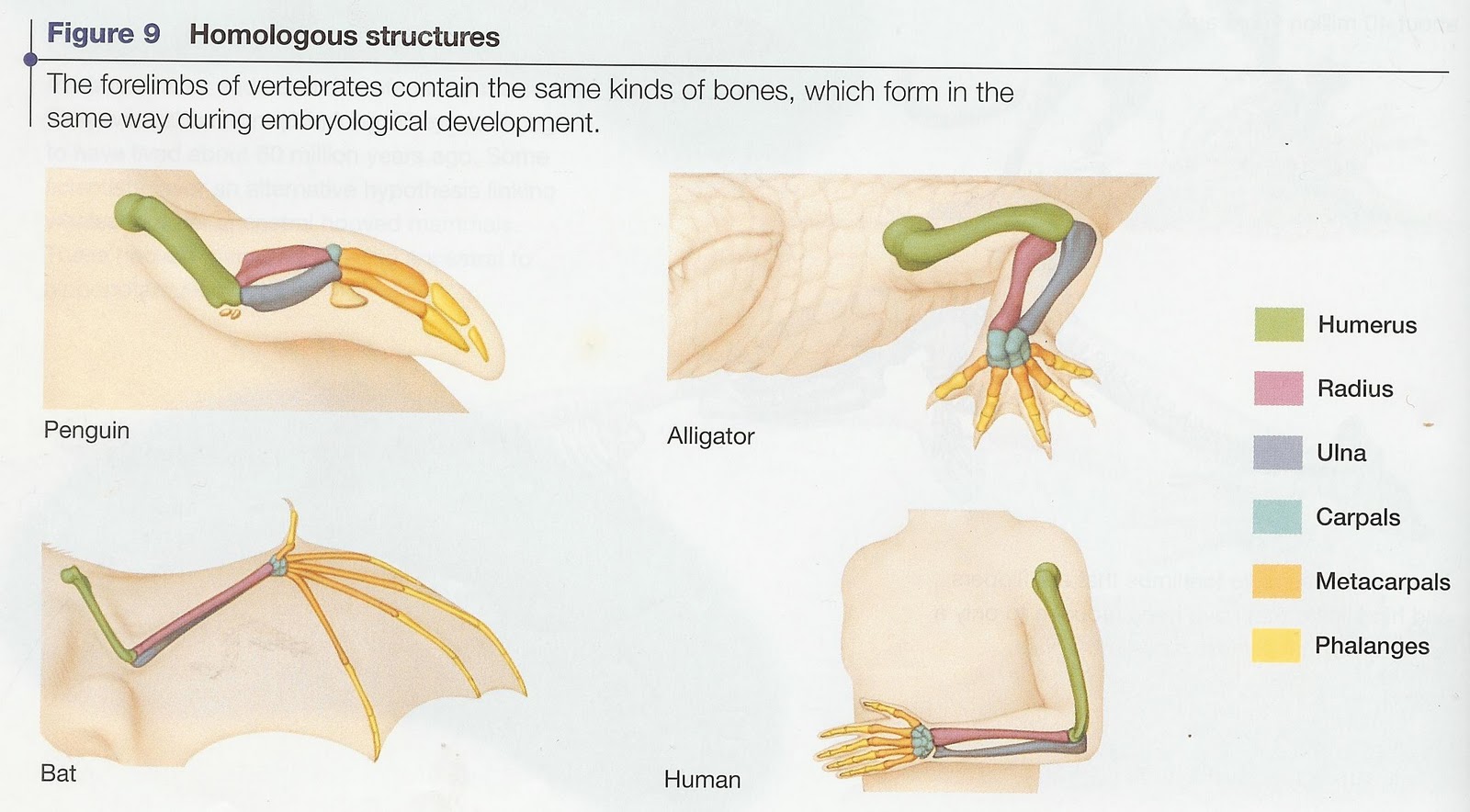
It is one of the most celebrated proof texts for evolution and at the same time a good example of what is wrong with the life science’s dominant paradigm. The pentadactyl structure—five digits (four fingers and a thumb for humans) at the end of the limb structure—is found throughout the tetrapods. The activities of this massive group of fauna include flying, grasping, climbing and crawling. Such diverse activities, evolutionists reason, should require diverse limbs. There seems to be no reason why all should need a five digit limb. Why not three digits for some, eight for others, 13 for some others, and so forth? And yet they all are endowed with five digits. And, evolutionists explain, this structure neatly fall into a pattern of common descent. Obviously the pentadactyl structure must be an artefact of common descent—a suboptimal design that was handed down from a common ancestor rather than specifically designed for each species. Darwin canonized this proof with one of his most cited passages:

What can be more curious than that the hand of a man, formed for grasping, that of a mole for digging, the leg of the horse, the paddle of the porpoise, and the wing of the bat, should all be constructed on the same pattern, and should include similar bones, in the same relative positions?

Curious indeed. This example is today a staple in the apologetics literature. Look in any textbook or popular work demonstrating the fact of evolution, and you are likely to see a graphic showing various pentadactyl structures in the tetrapods. Here is how evolutionist Mark Ridley echoes Darwin’s original interpretation in his Evolution textbook:

Other similarities between species are less easily explained by functional needs. The pentadactyl (five-digit) limb of tetrapods is a classic example. … Tetrapods occupy a wide variety of environments, and use their limbs for many differing functions. There is no clear functional or environmental reason why all of them should need a five-digit, rather than a three- or seven- or 12-digit limb. And yet they all do. … The evolutionary explanation of the pentadactyl limb is simply that all the tetrapods have descended from a common ancestor that had a pentadactyl limb and, during evolution, it has turned out to be easier to evolve variations on the five-digit theme, than to recompose the limb structure. If species have descended from common ancestors, homologies make sense; but if all species originated separately, it is difficult to understand why they should share homologous similarities. Without evolution, there is nothing forcing the tetrapods all to have pentadactyl limbs.

Here is how the Public Broadcasting Service evolution site explains the evidence:

The limbs of tetrapods all have the same pattern of bones. Darwin was one of the first to comment that it seems unlikely that this single skeletal structure could be the best one possible for each of the activities it is required to perform in different animals. … If you want to see concrete evidence of evolution, look no further than your hand or your foot. Five fingers, five toes. There's nothing magical about the number, yet five digits at the end of their limbs is a motif that runs through all the animals with four limbs, called tetrapods. … Pentadactyly (having five digits) is, in fact, an accident of evolutionary history.

And here is how evolutionist Douglas Futuyma put it:

If God had equipped very different organisms for similar ways of life, there is no reason why He should not have provided them with identical structures, but in fact the similarities are always superficial.

But as usual, the evolutionary apologetics are less convincing than evolutionists believe. In this case there are four different problems with this evidence and the evolutionary arguments.

Four problems with the evidence

The first problem is that evolution has no scientific explanation for the origin of the pentadactyl structure. Amazingly, evolutionists cannot account for the evolution of the very structure they claim proves their theory.

The second problem is that evolutionists are having it both ways. When they find a biological pattern, such as the pentadactyl structure, they claim it is a sign of evolution’s contingencies. Evolution, they say, can only work with the limited raw materials and designs that are immediately available. It knows not where it goes, and so you have patterns that, while workable, are less than efficient.

But on the other hand, evolutionists also claim ownership of all of biology’s fantastic designs. In fact, evolutionists claim ownership of all of biology, period. That’s right, evolution is supposed to have created everything in the biological world. Walk through any life science library and in the stacks you will see a seemingly endless supply of archived journals covering the seemingly endless list of subjects that comprise the life sciences. All of this is little more than scratching the surface of the biological world. We have learned so much, and yet have so much more to learn.

And according to evolutionists, it all came from evolution. All the DNA, proteins and organelles. All the millions and millions of different species, including all their fantastic and unique designs. All of biology. Though evolutionists do not know how, they are certain these all were the creation of evolution.

Evolution, apparently, is an incredibly imaginative and powerful design and creation tool. It can do it all. And yet, when evolutionists find a pattern, this they say is due to how clumsy their process is. Evolutionists aren’t fooling anyone, they can weave a story for any occasion.

The third problem is that similarities such as the pentadactyl structure in fact do not fit the expected pattern of common descent. In spite of all the textbook propaganda, the empirical evidence is all over the map. There are all kinds of digit patterns, both extant and in the fossil record. As Stephen Jay Gould once admitted, “The conclusion seems inescapable, and an old ‘certainty’ must be starkly reversed.” And as one recent study concluded:

Our phylogenetic results support independent instances of complete limb loss as well as multiple instances of digit and external ear opening loss and re-acquisition. Even more striking, we find strong statistical support for the re-acquisition of a pentadactyl body form from a digit-reduced ancestor. … The results of our study join a nascent body of literature showing strong statistical support for character loss, followed by evolutionary re-acquisition of complex structures associated with a generalized pentadactyl body form.

In other words, morphological patterns in biology, including the pentadactyl structure, do not fit the common descent model. This has evolutionists doing mental gymnastics as limbs and other designs must come and go as needed to make sense of evolution. They are lost, then reevolved, then lost, then whatever. It is all just storytelling.

Finally, the fourth problem is that the argument for why the pentadactyl structure proves evolution is metaphysical. Darwin’s argument, and those before and since are all about evolutionists non scientific premises about how biology should work and be designed. Surely god would never use such a thing as the pentadactyl structure in so many different species.

This, of course, is nothing more than religious rationalism. This silliness opens science up to all manner of argument. Imagine if there were no patterns such as the pentadactyl structure. If the designs were all different and somehow optimized for their respective applications, then evolutionists would point to that as evidence of natural selection choosing the best design. If God created the species, they would argue, wouldn’t we see some pattern? Instead, all we see is adaptation. Why wouldn’t God leave some sign that they were created instead of making the species appear to have evolved by natural processes? Evolution must be true.

It is, in a word, junk science. Religion drives science, and it matters.

Friday, December 2, 2011

Is Martin Mahner an Anti-Realist?

In his new paper on why science must presuppose metaphysical naturalism (the view that there is no supernatural, but only a materialistic world) Martin Mahner largely ignores questions of completeness and realism. Indeed, completeness goes unmentioned and Mahner’s only mention of the question of realism versus antirealism is in an end note where he dismisses the issue as not too relevant:

… there is an ongoing realism/antirealism debate in philosophy. However, this debate concerns mostly epistemological problems regarding the justification of more detailed realistic claims such as the status of unobservable entities, the truth of scientific theories, etc.

Well perhaps questions of completeness and realism are not what Mahner wants to address in his paper, or perhaps they are just inconvenient. In any case, Mahner is stuck with losing one or the other. As we have discussed before, such as here, here and here, those who mandate method necessarily lose a guarantee of either completeness or realism.

Bacon forfeited completeness and Descartes forfeited realism, but evolutionists will forfeit neither (which is possible only by introducing additional metaphysics which, of course, evolutionists do).

When mandating methodological or metaphysical naturalism, questions of completeness and realism immediately become important. But evolutionists want simply to mandate naturalism without reckoning with the implications. Mahner’s paper, unfortunately, does nothing to remedy this.

Thursday, December 1, 2011

East of Durham: The Incredible Story of Human Evolution

Imagine if Galileo had built his telescope from parts that had been around for centuries, or if the Wright Brothers had built their airplane from parts that were just lying around. As silly as that sounds, this is precisely what evolutionists must conclude about how evolution works. Biology abounds with complexities which even evolutionists admit could not have evolved in a straightforward way. Instead, evolutionists must conclude that the various parts and components, that comprise biology’s complex structures, had already evolved for some other purpose. Then, as luck would have it, those parts just happened to fit together to form a fantastic, new, incredible design. And this mythical process, which evolutionists credulously refer to as preadaptation, must have occurred over and over and over throughout evolutionary history. Some guys have all the luck.

In fact this incredible string of serendipity must extend all the way down to the molecular level. This is because different species have similar genes and proteins, and evolutionists must assume that these molecular similarities originated in a common ancestor. In other words, the proteins had to have been already present before the new species evolved.

Consider, for example, the human and chimpanzee. There is great similarity in most of the protein coding genes in humans and chimps, and evolutionists must assume those genes were already present in the supposed chimp-human common ancestor. So how did humans evolve? Evolutionists must conclude that it was not so much the evolution of new proteins (though that too must have occurred but that’s another incredible story) or the modification of existing proteins (though again that also must have uncannily occurred making for yet another incredible story), but the evolution of when and how many of those proteins are expressed. As one Duke University research team concluded:

The finding that neural adaptation has occurred mainly via noncoding changes is particularly important in view of the remarkable cognitive innovations in the human lineage.

Yes, that is remarkable. It would be as though the parts for the telescope or the airplane had been lying around for eons, just waiting to be used to form a new wonderful design.

Religion drives science, and it matters.

Tuesday, November 29, 2011

Pop Quiz: Who Believes and Promotes the Fixity of Species Belief?

Historians will point to the eighteenth century Swedish super-scientist Carl von Linne, or Linnaeus, as a key figure in the history of thought who promoted the religious belief that once created, all species remain fixed throughout history.

That answer gets an F because not only did Linnaeus soften his views and no longer accept the fixity of species in his later years, but the question is not in the past tense. The question is in the present tense. Who believes, not believed, in the fixity of species.

Ah, that’s easy. Creationists, right? Wrong again. Go back and do your homework, or if you must, see the next line where the answer is given backwards:

stsinoitulovE

Yes, it is they who believe in the fixity of species. After all, modern evolutionary thought arose in the highly religious culture of seventeenth and eighteenth century western Europe. It was motivated by, and inherits religious ideas from that day. It is, in fact, stuck fast to its centuries-old metaphysical foundation. Far from the cutting-edge science it purports to be, evolution is little more than today’s ossified remains of long-since discarded religious ideas.

For example, as one of the major pillars of evidence for their theory evolutionists cite the adaptation of organisms that we observe in the laboratory and in the field. It is, according to evolutionists, a powerful proof text for evolution. There is a constant stream of evolutionists insisting that such evidence proves evolution to be a fact.

It is as if they are forever stuck in the nineteenth century, replaying Darwin’s marvel at how differing bird populations “undermine the stability of species.” Like Sisyphus forever pushing the rock up the hill, they are forever pushing the absurd idea that resistance to pesticides and antibiotics in plants and microbes, respectively, make evolution the only possibility because as Darwin believed, if God created the species they would be fixed.

As Ernst Mayr pointed out, the doctrine of fixity of species was a key barrier to overcome if the concept of evolution was to flourish:

Darwin called his great work On the Origin of Species, for he was fully conscious of the fact that the change from one species into another was the most fundamental problem of evolution. The fixed, essentialistic species was the fortress to be stormed and destroyed; once this had been accomplished, evolutionary thinking rushed through the breach like a flood through a break in a dike.

And indeed evolutionary thinking eventually did rush in, on the power of metaphysical arguments such as this one. But these powerful religious motivations don’t just go away. Indeed, they provide the justification and motivation in the face of daunting scientific contradictions. And so to this day, evolutionists continually repeat their mantras from centuries past. Here is a typical example of how, today, the religion has become so ingrained in evolutionary thought. Below the video is the text beginning at the 9 second mark.


[0.09] What we study is how viruses and bacteria and other microbes get inside your body to infect them. And what I wanted to talk to you about today was how evolution is involved in that process, and basically why we think evolution is very important to understand.

So, when you get infected by a virus or a bacterium, there is basically a war going on inside your body, where the virus wants to multiply, or the bacteria wants to multiply, and your immune system wants to keep it back down. Now what happens is that, we as humans have evolved over millennia to actually have specific cells and those cells have particular receptors that will get rid of the virus or kill it or sequester it or some way make it so that it can’t infect you and make you sick.

Now the virus then, is evolving inside our bodies to get around that immune system. And if you look at the genes inside viruses, sometimes they steal long stretches of genes from their host, and other times they have mimics of genes in their host. So basically, viruses have this tremendous chance to evolve inside of people, that is their host, so they can get around an immune system.

So a successful virus would be something like influenza virus, that changes every year. So what it does is it mutates. It makes a lot of different forms of itself. Most of these are completely useless—that is they are defective viruses. But out of the millions and millions of viruses that it makes, one or a few of those will be better, and those will go on and multiply and infect other people.

That is evolution at work.


So basically, the viruses make millions of copies of themselves, most of them are worse. They’re making random mutations, random changes. They don’t know beforehand what’s good or what’s bad. The best ones will win out, and those will go on and infect.

In the same way, people have evolved, but over a much slower time scale. So that they made some changes in their immune system, to keep up with particular viruses and other changes that were actually worse. And the changes that were beneficial gradually win out.

So in a nutshell, that’s an example of evolution, at play, in your body, that goes on all the time.

And so I think we need to understand this, because bacteria in particular are able to mutate to get around antibiotics. It’s another example of evolution. We need to understand this, so that we can develop drugs that will actually get around bacteria’s incredible ability to evolve quickly, to get around the drugs we use today. Thank you.

For many this just proves that evolutionists are liars. Or that they are fools.

But when evolutionists such as Professor Bjorkman make these arguments, they are not consciously lying. Here Professor Bjorkman is smart, knowledgeable and honestly speaking her mind.

So how to explain evolutionists, such as Bjorkman, when they present their evolutionary absurdities with all the earnestness of a five-year-old talking about Santa Claus? It isn’t from ignorance or from deceit.

Religion drives science, and it matters.

Research Sheds Light on How the Brain Responds to Stimulus and Learns

It’s no surprise that the brain is profoundly complex. We discussed here, here and here that the brain contains hundreds of billions of nerve cells which are connected via hundreds of trillions of synapses. That a single synapse is like a microprocessor (although far more complex of course), with both memory-storage and information-processing functions and thousands of molecular switches. That a single human brain has more switches than all the computers, routers and Internet connections in the world. That evolutionists now admit that the brain’s complexity is beyond anything they’d imagined, almost to the point of being beyond belief. That evolutionists insist it is a fact that the brain evolved, and yet fail miserably to explain how such an incredible event occurred, or even how we could know it to be a fact. It just is, because, ultimately, it boils down to metaphysical claims about what must be true, scientific evidence be damned.

But all of this is, as usual, only one small sliver the evolution’s absurdities. For if the brain itself is complex, consider what it does. For instance, the brain is a fantastic learning machine. As a baby explores its environment it learns, and in this process a massive array of molecular switches and controls are adjusted within the brain.

One research study, for instance, found 12,000 segments of DNA (which as usual evolutionists had thought were mere oddities) that are transcribed in response to environmental stimuli. This is the first step in the brain’s process of responding, adjusting and learning. These DNA segments, known as enhancers, influence gene expression which in turn influences how the brain’s neurons function and communicate with each other.

Presumably learning processes such as this lead to knowledge. But does knowledge lead to wisdom?

Global Warming Quandary Resolved

In light of last week's release of more emails revealing ulterior motives of climate researchers, we felt a reprint of our reporting of an overlooked breakthrough resolution to the entire quandary was in order. --Ed.

New research out this week has resolved a long-standing, and important, quandary about the causes of global warming. While several models point to anthropogenic CO2 and other greenhouse gases as the leading cause of global warming, the warming trends do not quite match the history of anthropogenic CO2. In fact, shrinking glaciers and other undeniable evidences of warming trace back to about the mid seventeenth century. But this predates the significant rise in anthropogenic CO2 that came in later centuries. Now environmental researchers have solved the puzzle. While CO2 is undoubtedly an important factor in certain warming events, by far the most significant cause is the hot air emitted by evolutionists. In other words, anthropogenic theory rather than anthropogenic industry is the root cause of global warming.

What is particularly convincing about the new research is how precisely the earth's temperature correlates with major discharges of evolutionary hot air. As the figure illustrates, temperature spikes over the past three and a half centuries align perfectly with the history of thought. The correlation is simply too uncannny to doubt. Only the "flat-earth" warming deniers will find a way to explain this away.


In fact just today Canadian researchers recorded a significant warming event, which they were able to localize to a region over central Canada and the northern midwest of the USA. The timing (and location) correlate perfectly with a blog published by evolutionist PZ Myers entitled "The Ubiquity of Exaptation" where Myers pollutes science with a particularly acute hot gaseous emission. In fact one of the researchers, using a new experimental localization algorithm, believes he has traced the emission to a city block where, as it turns out, Myers resides. The researcher believes Myers wrote the blog from his home office.

In that blog Myers made several asanine statements about the evolution myth. In particular Myers emitted seemingly hilarious, but in fact environmentally dangerous, statements about the evolution of the nervous system. These included:

We use variations in these voltages to send electrical signals down the length of our nerves, but they initially evolved as a mechanism to cope with maintaining our salt balance.

I concluded this section by trying to reassure everyone that their brain is something more than just a collection of paramecia swimming about. Although the general properties of the membrane are the same, evolution has also refined and expanded the capabilities of the neuronal membrane: there are many different kinds of ion channels, which we can see by their homology to one another are also products of evolution, and each one is specialized in unique ways to add flexibility to the behavioral repertoire of the cell. The origins of the electrical properties are a byproduct of salt homeostasis, but once that little bit of function is available, selection can amplify and hone the response of the system to get some remarkably sophisticated results.

Once again, the cell simply reuses machinery that evolved for other purposes to carry out these functions.

The Trichoplax genome has been sequenced, and found to contain a surprising number of the proteins used in synaptic signaling…but it doesn't have a brain or any kind of nervous system, and none of its four cell types are neurons. What a mindless slug like Trichoplax uses these proteins for is secretion: it makes digestive enzymes, not neurotransmitters, and sprays them out onto the substrate to dissolve its food. Again, in more derived organisms with nervous systems, they have simply coopted this machinery to use in signaling between neurons.

We also contain a great many possible signals: long- and short-range cues, signals that attract or repel, and also signals that can change gene expression inside the neuron and change its behavior in even more complicated ways. It's still at its core an elaboration of behaviors found in protists and even bacteria; we are looking at amazingly powerful emergent behaviors that arise from simple mechanisms.

You can see how extreme was this incident of evolutionary story telling. But what we once thought were merely hilarious and asanine mythological narratives are now clearly very, very dangerous environmental toxins. The bad news is that evolutionary theory far exceeds anthropogenic CO2 as the leading cause of global warming. The good news is that we now understand the cause.